For those of us who witnessed the appearance, grotesque growth and eventual death of the tail-fin and the disappearance of the Packard Motor Car Company in the 1950’s, General Motor’s current woes are brilliant irony.
Behind the scenes as the tail-fin craze initiated by the 1948 Cadillac reached its high-water mark with the 1957 Chrysler Corporation product line (“Suddenly, It’s 1960!”), Harley Earl and his GM design center created a monster. The monster appeared innocent enough and delivered handsome benefits to the corporation. GM’s divisions could share basic sheet metal and differentiate themselves with design variations that altered only a part of the car.
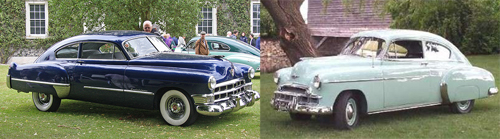
In 1954, my brother and I bought a 1949 fastback Chevrolet whose body – not counting trim and the tail fins on the rear fenders – was essentially the same as that year’s Cadillac fastback. It became the practice to create, say, a half-dozen body styles and then share them across the five GM brands. This (because of selective sharing) would result in perhaps 20 to 24 base models for GM, giving them plenty of variety to offer the public through the dealers of their five brands.
The Packard Motor Car Company, which (1) had never done their designing in-house, (2) was still preoccupied with making aircraft engines for the government, and (3) because of the pressures of the Depression had pushed the lower limits of their model prices below $1000 while trying to maintain a prestige, elitist image, suddenly had to compete with GM’s definition of automotive style. They reacted slowly, finally achieving a model that gained good consumer acceptance in the 1950 model year.
Unfortunately for them, the lack of integration between outside designers and Packard engineering caused considerable delay in getting the car bodies to “fit” properly. Leaks and rattles abounded and deliveries were disastrously slow. The following year, due to the Korean conflict, steel was put on rationing and car companies could make no more vehicles than they had in the previous year. With their output constrained, Packard went belly-up and into the waiting arms of Studebaker Motors, which coveted Packard’s defense contracts but not their automobiles.
The ’50’s were, nevertheless, heady times for the US auto industry. Horsepower became a competitive factor in consumer decisions and the industry tried hard to induce increased consumer purchasing by radically changing each car’s exterior sheet metal every year from 1955 through 1959. This practice gave credence to the notion that US car manufacturers were practicing planned obsolescence, a term coined in 1954 by industrial designer Brooks Stevens to describe a method for speeding up the repurchase cycle through non-functional design changes.
Tail-fins were re-absorbed by automobile bodies at the beginning of the 1960’s, although Cadillac retained vestigial fins until the mid-60’s. This may have been a recognition by automakers that style changes alone could not accelerate purchases and signalled a switch to what became a three-year cycle for major changes to body style.
But because they are production-oriented, all US automakers shared common bodies across their brands, diluting the meaning of the individual brand names. Fords could be the size of Lincolns, Plymouths were essentially identical with Dodges; GM tried to establish a Cadillac compact car, the Cimarron, in 1981 by embellishing the same compact body used by other GM divisions, and tried it again in 1997 by re-purposing a body produced by GM’s German Opel division to create the Catera. In both instances, GM discovered that people really didn’t want cheapness disguised as luxury. (A good overview of GM body types over the years is available at Wikipedia.)
[Sharing bodies and other parts was so widely practiced that it came as a shock to me that Oldsmobile owners in the 1970’s brought a lawsuit against GM because their vehicles had come with Chevrolet engines. GM then declared all engines as corporate rather than division “property.”]
The GM brand in biggest disarray is Chevrolet. Chevrolet is the GM entry level brand, and to ensure that it keeps that position, GM has used its equity stake in the South Korean automaker Daewoo to obtain the car sold in the US as the Chevrolet Aveo (and, following the GM body-sharing model, the Pontiac G3) starting at $12,000. On the other end of the spectrum is the Corvette, selling for between $50,000 and slightly more than $100,000; the Corvette XR1 starts at $106,000.
[Some people might complain that Chevrolet is the name of a division, not a brand. But this ignores the fact that Chevrolet has always been quite (…wait for it,…wait for it…) cavalier* with respect to their model names, creating them, casting them away, and resuscitating them without regard to any possible “equity” attaching to them.]
[*Chevrolet Cavalier, 1982 – 2005; replaced Monza, replaced by Cobalt]
[If Chevrolet nurtured their models as brands I think I might have no argument. A quick review of Chevrolet’s models gives an average age of 13 years; if the two oldest models – Corvette and Suburban – are removed from the list, the average age is something less than six years. When the average automobile repurchase cycle is somewhere around four years, a six-year model life suggests that few people will even have the opportunity to repurchase a satisfactory model. By contrast, the Chevrolet brand has been around for 98 years.]
In the spectrum of Chevrolet models, the large SUV entry is the Tahoe whose body is shared with the GMC Yukon and the Cadillac Escalade; the smaller large SUV is the Traverse whose body is shared with the Buick Enclave, the GMC Acadia, and the Saturn Outlook. In a class (“jumbo SUV,” according to Edmunds.com) almost by itself is the venerable Chevy Suburban (body shared with the GMC Denali X) with a price starting around $38,000. The fourth and smallest SUV entry for Chevrolet is the Equinox, also available as the Pontiac Torrent.
Chevy’s sedans come in many sizes, from the larger Impala down through Malibu, HHR and Cobalt, with the bodies shared with other GM divisions. Chevrolet has announced that the Cobalt model name – only about four years old – will be retired in favor of the Cruze model name in 2011.
Trucks, all duplicated in offerings by GMC, are the full line of Silverados and the compact Colorado (GMC Canyon). The “convertible” pickup/SUV Avalanche is echoed by the Cadillac Escalade EXT.
With minivans fading as a popular vehicle type, GM exited the US minivan market in 2009 after 20 years of relatively futile pursuit of the Chrysler market leaders. Models were shared by Chevrolet, Pontiac, and Oldsmobile; a Buick minivan (under the GL-8 model name) is currently available in China and apparently selling very well.
[Having owned one of the original GM “dust buster” minivans (the Oldsmobile Silhouette), it was my impression that GM stylists had never actually spent any time in or around the vehicle. A highly-touted feature, individually removable and re-configurable seats in the back two rows, required muscling around unwieldy 50-pound seats with claw-like feet. Access to the rear seats was awkward in the initial models, so when the snoutless revision to the body type was released in 1997 I was shocked to discover that the new models were just as difficult to enter as their predecessors. So I bought a Plymouth minivan…two moribund auto brands in a row.]
That leaves the 2010 Camaro as the final model on Chevy’s list, the re-introduction of the “personal” sports car that was GM’s initial response to Ford’s Mustang. The body is the GM Zeta body developed in Australia that in the US is only shared with the Pontiac G8 series (a sedan configuration). This time, however, there is no accompanying Pontiac Firebird, perhaps recognition that the more limited Pontiac distribution network would not deliver sufficient additional sales to warrant the design, execution and marketing expense of a variant for that brand.
On the horizon is GM’s electric car, the Volt, which will – at least in its initial incarnation – wear the Chevrolet bow tie. I would argue that this vehicle represents a unique branding opportunity, the establishment of a marque devoted to the best in green technology; an opportunity that will be squandered in order to leverage the Chevrolet dealership network and to leave open the possibility of a later Buick or Cadillac model. The fact that its entry-level price has crept all the way to $35,000+ before its actual introduction suggests a n0n-Chevrolet price point.
The point of this litany is to serve as preface to the idea that if you were to ask someone what the Chevrolet brand represented there could be no clear reply. “All things to all people, usually a little cheaper and less prestigious” might do. A good contrast can be made with Toyota’s Camry brand. If you say to yourself, “I want a Camry,” you have a good picture of what it is you’re after. If you say to yourself, “I want a Chevrolet,” you haven’t specified anything except that sort of gnawing suspicion that you don’t really want the best.
The Chevrolet division people are proud of the breadth of their product line and are aware of the identity problem that that causes. Their response, however, has not been to consolidate models but rather to “unify” their offerings by increasing the size and prominence of the Chevrolet “bow tie” emblems on the front and rear of their offerings.
Branding by labelling is a valid concept. It works well for things like jams and jellies. The uniformity of labelling assures us that each variety of Smucker’s products is of the same quality as the others. But even Smucker’s runs into problems when their name goes on a ketchup label: Different product, different process, different end use.
Back to the Packard Motor Car Company. They made their reputation as a luxury brand building sixteen-cylinder motors to create smooth-running vehicles. From 1920 to 1930, they tried to capture a lower tier of the market by introducing cheaper vehicles but they just didn’t understand how to do that. The vehicles ended up being bigger than the competition’s and Packard ended up charging more. Ironically, GM hired Harley Earl to come to Detroit and design the LaSalle, a brand created to allow GM to compete for that same lower tier without sullying the Cadillac brand (“LaSalle by Cadillac”).
When the Depression hit, Packard had no choice. Hiring GM managers, they shifted from job shop to production line methods and completely shook up the dealer network. They learned how to build cars cheaply and sell them for lower and lower prices. They eliminated their largest vehicles from regular production. (In the language of the times, they eliminated the “senior” chassis and built the top-of-the-line production vehicles on the “junior” chassis along with the rest of the line.) They continued to use the Packard brand, and by 1936 they offered cars at prices from $795 to $8,510, an extremely broad price range.
[An interesting issue is the sustainable price difference that a single brand can present from its lowest-priced offering to its highest-priced. A corollary question might be what price difference would be sufficient to differentiate a quality product from a commonplace product. Smucker’s grape jelly commands a 33% price superiority over Shop and Stop’s store brand. A Cadillac Escalade XLT commands a 60% increase in base price over a Chevrolet Avalanche. In light of these numbers, sustaining more than a 100% price difference across models of the Packard brand seems to be stretching the limit.]
The Packard brand came to compete with Plymouth, Chevrolet, and Ford. By the time the first post-war models were released in 1948 and 1949 Packard was no longer a luxury brand, but they did try to restart their competition with Cadillac. As recounted earlier, that struggle died before it was fully undertaken.
Chevrolet today tries to offer a range of cars, trucks, and SUV’s with starting prices from $12,000 to $106,000 and to tie them all together with a golden bow tie on the grille and trunk. Virtually all of its models are available from the same company at higher finish levels so it cannot compete on a claim of superiority. It’s a tough marketing job to compete on a claim of modestly-priced mediocrity. But it was apparently doable as long as the economy was buoyant.
Max Warburton at Bernstein Research says, “GM has always resorted to aggressive pricing. GM has been the leading exponent of oversupply, cheap financing and deflationary strategies.” In this conceptualization of the market, GM focuses on production and pushes its products into the marketplace by sustaining price disadvantages vis-a-vis its foreign competitors. The GM brand divisions are merely outlets for their production facilities and sales are achieved largely through price strategies.
Continuing his argument, Warburton says, “…the massive price disadvantage that GM and Chrysler suffer – with their small cars selling at US$3,000 below Honda/Toyota levels, their midsize SUVs US$6,000 below and their large cars selling for US$10,000 less. GM and Chrysler have a price problem more than a cost problem. This is a brand issue – and the brands won’t be fixed by Chapter 11.”
In marketer’s terms this would be a statement that GM’s brands have a negative equity position when compared with Honda and Toyota. And if Honda and Toyota are the competition, then the Chevrolet division must be the primary offender.
Warburton goes on to contend that GM and Chrysler are primarily (from a profitability viewpoint) light truck manufacturers and that the two companies should merge to produce (1) a single small front-wheel drive model, (2) a single minivan model, (3) a single mid-sized crossover or SUV model, (4) a single pickup model, and (5) a single rear-wheel drive large sedan.
The idea that GM (much less a merged GM-Chrysler company) should reduce itself to only five models is radical in the extreme. Cadillac would produce the large sedan, GMC would produce light trucks, Buick would produce the crossover/SUV, and Chevrolet would produce the small car: Since GM has given up minivans, that model would disappear from GM’s repetoire.
Given GM’s penchant for body sharing, perhaps the following lineup would be more realistic:
- Cadillac – Luxury large sedan, luxury SUV/crossover
- Buick – Value large sedan, value SUV/crossover
- Chevrolet – Small car (value through luxury), specialty cars (personal sports, sports, electric)
- GMC – Light trucks (pickups, vans, commercial use vehicles)
As Warburton points out, the deep problem at GM is a brand problem, and the solution to that problem requires a turning away from production and pricing as a basis for strategy and the adoption of strong branding. It is not likely that the current GM division hierarchy can adapt to this model.
It is, however, interesting to reflect on the lasting impact of Harley Earl’s centralized GM design center that hastened the demise of the Packard Motor Car Company (and other independent producers) and allowed GM to practice its production mentality right up until the day they filed for bankruptcy.
(Kick as kick can is obviously an oblique reference to “kick (him) while (he’s) down,” which – I guess – signifies that I recognize that I’m taking unfair advantage of a venerable US institution. But that Oldsmobile Silhouette really was a POS no matter how I tried to love it.)
GM has always resorted to aggressive pricing. GM has been the
leading exponent of oversupply, cheap financing and deflationary strategies.GM has always resorted to aggressive pricing. GM has been the


 <yxxxxxx@gmail.com>








 Cabbages and kings

Auto rants (Part 2)
Chrysler set a record for passage through bankruptcy, just in time for GM – a more complex financial beast – to emerge even more quickly: In on the First of June, out on the 10th of July. Three days later, Advertising Age asked the first-page rhetorical question “Is this the right guy to run GM’s marketing?’ next to a photo of Bob Lutz.
The answer to that question should have been clear from the July 14th Wall Street Journal headline advising that Mr. Lutz was toying with the idea of breathing some life into the almost-dead corpse of the Pontiac division by resurrecting the Chevrolet Caprice model name and putting it on the Pontiac G8.
The answer is no, Bob Lutz is not the right guy to run GM’s marketing.
He’s 77. He’s retired from GM once already. He is steeped in the tradition of the US automobile industry. The G8 fizzled after it’s 2007 introduction, but sales are picking up…so the logical conclusion is to make sure we hold on to this model, “citing nascent demand.”
In the depths of the Depression, Packard Motor Car company hired production and sales executives from General Motors because Packard didn’t understand how to make or sell a popularly-priced car to save their souls. It worked!
The equivalent in today’s market in which GM has been unable to sell automobiles profitably would be for GM to hire marketing and production executives from Toyota.
Mr. Lutz, you have to narrow the range of models offered by each of your surviving divisions, not broaden them; you have to reduce the overlap of models, not further confuse them.
Clarity, Mr. Lutz. Focus. One big winner, not a half-dozen stunted, resource-sucking minor models that you produce for inventory (not demand) and then have to liquidate.
July 14, 2009 1 Comment Short URLBob Lutz, Caprice, Chevrolet, G8, GM, Marketing, PontiacCommentary, Marketing