Toncontin Farewell

On the day we left Tegucigalpa (see the entry titled “Deciding Moments”) I decided to film the trip from the hotel to the airport. The resulting footage isn’t any better than handheld 8mm movies taken from a moving vehicle could be expected to be, but the street scenes are representative of what we saw each day going to and from our classroom site.

Every day we drove past the city’s only traffic light, installed only a year earlier. The city’s traffic had a much less regimented, more fluid flow than US streets. At one point in this movie, our truck is overtaken by two cars, one of which passes us as the other passes both us and the first car. It has much of the same feeling (with less congestion) as driving in Souzhou, China, at least as I experienced it in 2002.

The movie includes some footage from Toncontin airport itself. A single-engined aircraft takes off; note how quickly it is off the ground, because the next aircraft is a PanAm DC-6 that lumbers down the runway, keeps lumbering, and finally, away off in the distance, rises slowly as it passes over the end of the runway…and the dropoff that waits there.’

Deciding moments

Working on another video taken in Honduras in 1965, I am reminded that my trip there probably accounts for a pretty decisive turn in my thoughts about what I would take up as a career. It was the beginning of a decision to leave the military rather than stay in for twenty years and then take up teaching or some other career; of course, the events that were unfolding in Viet Nam at that same time would also play a part in that decision.

I went to Honduras with two other Army officers with the first Military Training Team dispatched to that country following the coup staged by General Osvaldo Lopez Arellano and the army in October, 1963. Although I was unaware of it as I arrived, our group’s appearance on the scene was regarded – at least by the US Military Attache – as an important event.

In the coup that toppled Ramon Villeda Morales, Lopez Arrellano had employed a considerable amount of equipment provided through US military assistance programs, while the forces loyal to the President had relied largely on equipment provided by the US Agency for International Development. In that sense, it had been a conflict in which the Defense Department was the backer of one side and the State Department backed the other side. This seems abstract until one realizes that during the conflict each of the fighting factions was communicating with “their” friends in the US Embassy. While, of course, the Embassy maintained official relations with the legally-constituted government.

The importance of our visit (to the US Military Attache) was to get the military assistance program back up and running and we were a part of that. But for me one of the “lessons learned” from this visit was that the change in government had resulted in a hiatus in US-supplied assistance to all programs. For example, travelling through the countryside there were a lot of unfinished school houses that work had been stopped on after the coup and it appeared that work might not begin again for a while (the schools had been USAID-supported projects initiated by Villeda Morales). I became disillusioned about the ability of government-to-government programs to actually deliver benefits to the people when the programs were so impacted by politics. Later I began to worry that the specifics of the programs were determined bureaucratically rather than by some market mechanism…but that’s a whole other story.

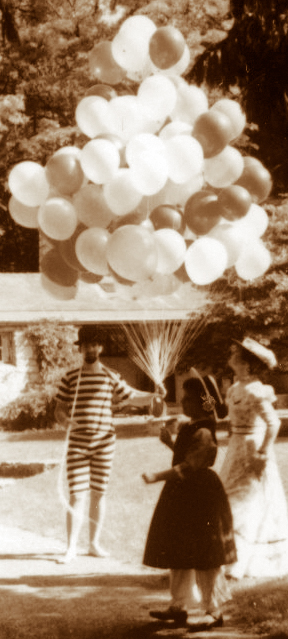
Hey, Mr. Balloon man…

Balloon man

Having posted the photo of my mother taken in 1917 or so, it’s not totally out of place to insert this one here. I’ve Photoshopped it for the sepia look, because the color of the original makes it obvious that it’s not a true period photo. It’s actually me at 17 (June, 1958) with the balloons. The occasion is my grandmother Josephine Strong’s 75th birthday celebration, in honor of which her siblings, children and grandchildren (and friends) dressed up in period clothing. My brother Walt and I found “bathing costumes,” lacking somewhat in originality but we ended up being the most comfortable people there.

The most notable thing, I think, was the excess involved in the balloon thing. For the afternoon event, we inflated balloons starting in the morning and continuing on through noon; my fingers were raw from tying the ends of the balloons. We were staging the balloons in the bunk house, and the strings hung down from the balloons forming a room-sized fringe. I think the point was that we had been given a whole great tank of helium and ‘way too many balloons and we just didn’t know when to quit.

We all have in our mind’s eye that picture of a balloon man with a fistful of strings attached to his wares, and in our mind’s eye that cloud of balloons above him is full, robust, and shaped not unlike a fat bush. Trust me, that fullness is not easily achieved. It was almost impossible to hold this group of balloons down for any lengthy period of time, and the tangling of the strings suggested that there was some secret real balloon men have not shared involved in being able to give to each child just the balloon they desire.

Adeline Carpenter Salmon

Yesterday morning my sister Anne called, something she never does. Mother had died during the night. She had lived in a nursing home for two years, crippled by a broken hip and arthritic joints, unable to get about except by wheelchair and specially-equipped vans.

But she had been travelling for some weeks, visiting friends and family, far away in place and time. She received a visit from her parents. Her imagination had slipped its bonds and made its way where she wanted to go. Towards the end it had been less important to get up in the morning.

Or at least these are the things that I imagine from the things that I have been told. From my perspective here on the rocky coast of New England this seems to have been a peaceful leave-taking. But I was not there, and only Anne can really say.

Adeline Carpenter Salmon

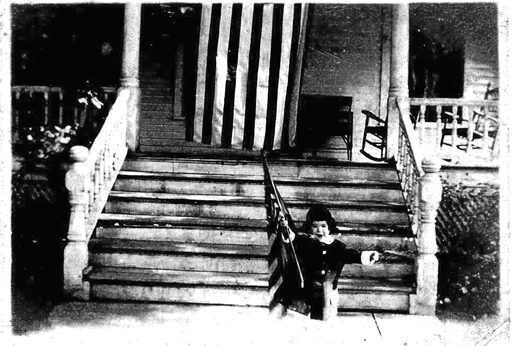
This photo carries the comment, “for Uncle Marion.” A search for him turns up a Marion S. Bonneville who enlisted in the Marines on May 28, 1917. Of the many muster rolls that mention him, the one below reflects his promotion to Corporal during April of 1919. So this must have been mom at a homecoming celebration (it can’t be the Fourth of July because of the heavy clothing she’s wearing).

musterrollapril1919.jpg

Bloggies Upeast

I teach at a private university within 100 miles of Boston; last Thursday I took a quick survey of my students – juniors, business majors – to find out how the nominees for the Bloggies fared. The results:

Best American weblog:
Perez Hilton 18
PostSecret 5
Boing Boing 2
Lifehacker 1

Best photography of a weblog:
101 Cookbooks 4
I can has Cheezburger? 3
Dooce 2
Smitten Kitchen 1

Best fashion weblog:
Go Fug Yourself 6
Jezebel 2
FabSugar 1
The Budget Fashionista 1

Best weblog about music:
Jhive 5
I guess I’m floating 2
Said the gramaphone 1
Idolator 1

Best gossip weblog:
PerezHilton 13
TMZ 10
Dlisted 3
Pink is the new blog 2
I’m not obsessed 1

Best entertainment weblog:
Best Week Ever 14
BuzzSugar 3
/Film 1

Best sports weblog:
Up in Alaska 2
Fat Cyclist 2
The Big Lead 2
Deadspin 1
Kickette 1

Best weblog about politics:
Daily Kos 3
Wonkette 1
Instapundit 1
Crooks and Liars 1
The Huffington Post 1

Best computers or technology weblog:
Geekologie 6
Wired 4
Gizmodo 1

Most humorous weblog:
PerezHilton 11
Dlisted 4
Go Fug Yourself 2
Overheard in New York 1

Best new weblog:
Sarcastic Mom 4
Jezebel 4
Ashley’s Closet 1
Local Girl’s Day in Pictures 1

Weblog of the year:
PerezHilton 10
PostSecret 6
GoFugYourself 4

Overall stats:
Number of students 52
Number with no choices (of 12 categories presented) 10
Number with only one or two choices 16

Travelogues by People Who Aren’t Going Very Far

 Harbor report: Low tide this morning, the WNW wind driving the surface slush to the eastern shore, particularly in the little protected cove at the head (north end) of the harbor. The woman who has been taking pictures of geese every morning since early last spring could find no geese on the eastern shore, so she left early. The geese had all moved to the cove at the northwest end of the bay, keeping close to shore. Four ducks in a little bunch had been surrounded by the geese and harmony prevailed until the ducks came up with something worth eating, at which point a couple of geese extended their necks towards the ducks who shuffled off in a little group as the geese enjoyed the tidbits. Shameful. Temperature at 24 degrees, wind at about 5 miles per hour. Only one sailboat left on its mooring this winter (about a 20 foot daysailer) compared with five or six last winter. The homeless guy who had to be hospitalized last January from exposure due to living on a sailboat in the harbor was back this year. He’d spent the summer in the lee of Prudence Island a couple of miles south of here where one of the residents gave him an additional sailboat, so the flotilla he arrived in Bristol Harbor with this winter was up to three boats: Two sailboats and his outboard-powered Quahogging skiff. Alas, on Christmas Day the new boat sank and this time the Harbor Patrol (an elegant name for a rather muscular outboard-driven 25 foot boat) towed the two remaining boats to the town dock and told the guy he was going to have to winter over tied up to land. According to the Bristol Phoenix, this does not sit well with him as he prefers to “live on the water.”

The Bridge – Tegucigalpa 1965

Market Day, Chichicastenango, Guatemala – 1964

Running in Audubon Park (New Orleans) at Dawn